Most hair dryer shopping happens on a phone, in an aisle, with a box in one hand. The box is loud. It promises shine, speed and smoothness, often with a technology name attached. This guide takes a quieter route. It does not rank models or name a winner. It shows you what a hair dryer is, which parts of the box carry weight, what owning one costs, and which protections are already yours by law, so you can judge any model on the shelf.
The market is large, which is why the checks are worth learning. The Consumer Product Safety Commission (CPSC) estimated that about 23 million hand-supported hair dryers are sold each year, according to its final rule on hair dryers. In 2007, the three largest suppliers made up about 92 percent of domestic sales, per the same document. A few makers sell under many names, so a different logo on the box does not tell you much about what is inside.
Five questions follow, in the same order every guide on this site uses, and then a checklist you can tick off in the store.
How it works
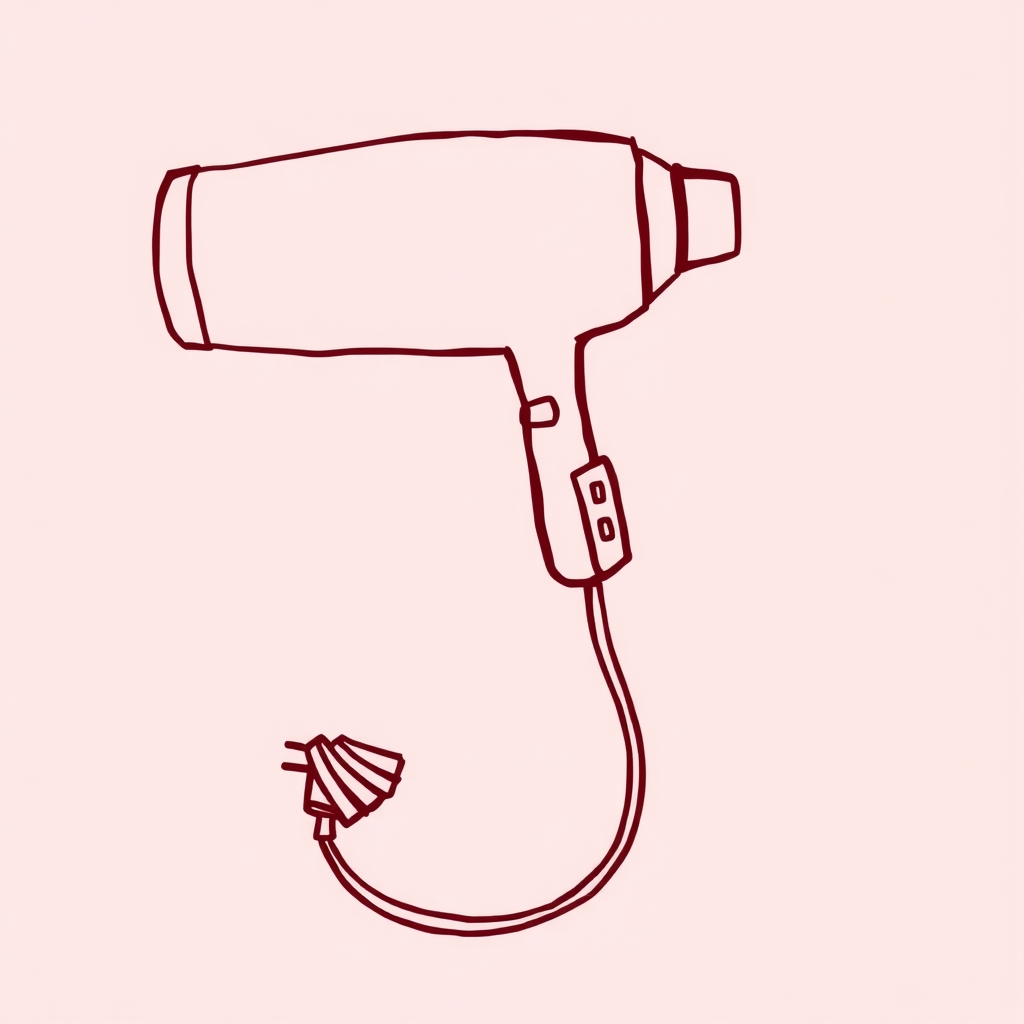
CPSC defines a hand-supported hair dryer as a one-handed appliance that blows air over or through a self-contained heating element to dry hair. That is the whole machine: a fan moves air, a heating element warms it, and a nozzle points it.
The heating element matters for safety. The final rule notes that hair dryers often use open-coil elements, which are uninsulated energized wires. If water reaches them, there is a path for shock or electrocution. That is why the plug on the cord is not a detail.
The protection works like this. Many dryers have a block-shaped plug with a circuit interrupter built in. The rule says these plugs use a GFCI, ALCI or IDCI, and usually carry Test and Reset buttons. The interrupter senses abnormal current flow and disconnects the dryer from power in a fraction of a second. CPSC calls this integral immersion protection, and it reduces the shock risk if the dryer touches water.
What matters
The plug comes first. CPSC has determined that hand-supported hair dryers without integral immersion protection are a substantial product hazard, and such dryers can be recalled. The rule took effect July 28, 2011, and is codified at 16 CFR 1120.3, which points to the UL 859 and UL 1727 immersion protection requirements. In the store, look at the cord. A block-shaped plug with Test and Reset buttons is what you are checking for.
The history shows why. From 1980 to 1986, before UL requirements, 110 water-contact electrocutions from hair dryers were reported, an average of 15.7 per year. After a 1991 UL revision, reported electrocutions fell to 12 across 1991 to 1997 and three across 1998 to 2007. Not every death involves water, though. Deaths in 2008 and 2010 were tied to fires that ignited a couch or mattress, and to thermal injuries from a running dryer. So handle a dryer as a heat source, and switch it off and unplug it when you put it down.
Be careful with "professional" labels. CPSC staff said in 2002 that "professional" dryers sold to consumers without immersion protection are considered defective and a substantial hazard. UL 1727, which covers commercial grooming appliances, has required the same protection as UL 859 since 1994, and such dryers may be consumer products. A salon label does not excuse a missing plug.
Wattage, airflow and "ionic" claims. None of the regulatory sources used for this guide set a standard for any of these, so there is no official scale to tell you what a good number is. What you can do is read the rating printed on the dryer or in the manufacturer's spec sheet. A recall notice for one older model, for example, listed it as rated 1875 watts, so the wattage is a printed fact you can find. Airflow and "ionic" are different: if the box gives a claim but no measurement, the claim is a description, not a spec. Ask for the manufacturer's spec sheet, and treat anything that lacks a stated measurement or test method as marketing until shown otherwise. A claim is not a protection either, and it should never stand in for the plug check above.
What it costs
The sticker price is only the start, and the sources here give few dollar figures, so this section is a method more than a table. One data point: a professional-labeled dryer in a 2002 recall sold for about $50 between December 2000 and January 2002. Treat that as an example of a price on a receipt, not a benchmark.
For your own total cost of ownership, add these items:
- Purchase price, including any add-on the register offers.
- Electricity. The wattage rating tells you how much power the dryer draws. Multiply by how long you run it each week, and compare against the rate on your utility bill.
- Replacement risk. A dryer that fails outside its warranty costs the whole price again. The warranty terms, covered below, set how likely that is.
- Extended coverage. The FTC says extended warranties and service contracts cost extra and are sold separately, and that the product's own warranty may already cover the same repairs. For a low-priced appliance, read what the add-on repeats before paying for it.
A lower-priced dryer with a clear warranty and the protective plug can cost less over its life than a pricier one whose terms you never read.
What protects you
Recalls. Federal law prohibits anyone from selling products subject to a CPSC-ordered or CPSC-consulted voluntary recall. Check a model name against CPSC recalls before you pay, and again if you are buying secondhand. Recalls do happen for the missing-plug problem. In one case, Babyliss Pro recalled about 23,000 hairdryers on August 29, 2002, because they lacked an immersion protection device on the cord. The dryers were labeled professional-only but could have been sold to consumers. The remedy was a free replacement with the device, and no incidents had been reported. The recall was done to prevent injuries.
CPSC can go further. Under its corrective action authority, the Commission can order a manufacturer, distributor or retailer to repair, replace or refund a product with a substantial hazard. Imported dryers with such a hazard must be refused entry to the United States. If you see an unsafe product, you can report it at SaferProducts.gov or through the CPSC hotline, 800-638-2772.
Warranties. The FTC's warranty guidance says that when a warranty exists, you must be able to read it before purchase, in store or online. Then read it for these points:
- Whether it repairs, replaces or refunds.
- Whether it covers misuse or only use following the directions.
- Which parts are listed. Assume anything not listed is not covered.
Keep the warranty and the receipt, because the receipt proves the purchase date and original ownership. State-law implied warranties, including merchantability, cover almost everything you buy and can last up to four years in some states. And if you report a defect during the warranty period and it is not fixed properly, the company must correct it even after the warranty expires.
What to ask
Take these to the shelf or the product page, and to a store employee if there is one:
- Does this dryer have a block-shaped plug with a circuit interrupter and Test and Reset buttons? If it says "professional" or "salon," does it still have one?
- Where is the wattage printed, and where is the manufacturer's spec sheet?
- When a box claims "ionic" or a strong airflow, what is the measurement or test behind it?
- Can I read the full warranty before I pay? Does it repair, replace or refund, and for how long?
- Does the warranty cover only use following the directions, or also misuse?
- Does the extended plan cover anything the maker's warranty does not already?
- Has this exact model appeared in a CPSC recall?
A store that cannot answer these is giving you information too. You can walk away, read the sources above, and buy later.
Before you buy checklist
Quick answers
How do I know a hair dryer has shock protection?
Look for a block-shaped plug on the cord with a circuit interrupter, usually with Test and Reset buttons. CPSC calls this integral immersion protection and treats dryers without it as a substantial hazard.
Does "professional" on the box mean it is safer?
No. CPSC staff said professional dryers sold to consumers without immersion protection are considered defective and a substantial hazard. A 2002 recall involved dryers labeled professional-only that lacked the cord device.
What should I read in a hair dryer warranty?
Check whether it repairs, replaces or refunds, whether it covers misuse or only use per directions, and which parts are listed. Parts not listed should be assumed not covered, and you should keep the receipt.