You are standing in the aisle with a $27.99 flat iron in one hand and a $289 one pulled up on your phone. They both get hot and they both press hair flat, so what is the extra money for? It comes down to your hair, how often you style it, and a few features that are easy to check before you reach the register.
The short version
- Most people need an iron with several heat settings, so they can match the heat to their hair.
- A basic one costs well under $100, and a step up is around $100 to $130.
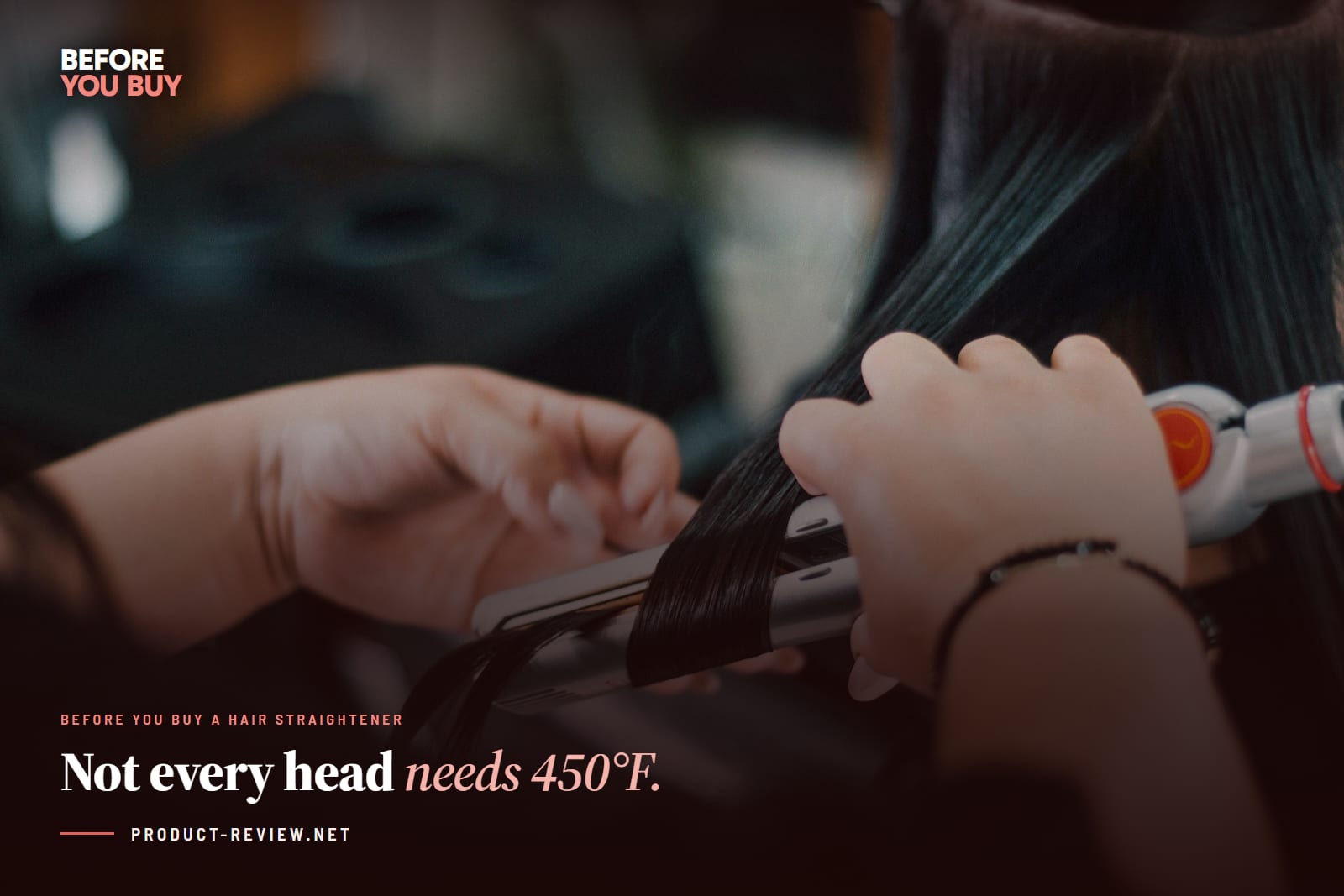
- Skip paying extra for the highest heat, since not every head needs 450°F.
Which kind fits you
Start with the plates, the part that touches your hair. NBC Select experts name three types. Ceramic suits dry, damaged or fine hair and is more affordable. Tourmaline works on all hair types. Titanium is durable and suits coarse, thick or curly hair. One maker adds that titanium is smoother and can grab more hair per pass, though both plate types can work well.
Then pick the width. Experts advise 1 to 2 inches. Smaller plates suit short hair and larger plates suit long hair.
Heat matters too. One stylist suggests about 250°F for fine hair, 250 to 350°F for medium to thick hair and 350 to 400°F for thick, coarse hair. So match the iron to your hair first, and let the price follow.
Features to look for
Adjustable temperature comes first. Experts recommend several settings so you can match the heat to your hair, and a stylist makes the same point. Even a basic iron can offer six settings, from 310°F to 410°F.
After that, the small things. A quick heat-up, around 30 seconds, helps on busy mornings. An auto shut-off, often set at 60 minutes, is handy if you leave the house in a rush. Weight is worth a hold in your hand, since a light titanium iron can come in at 0.88 lb. Check the manual too, because some makers say to use their iron only on dry hair.
Last, look at the top temperature. If your hair is thick and coarse, you want an iron that can reach up to 400°F.
Upgrades worth paying for
Each of these is worth it only for certain people.
- Titanium plates, for thick, coarse or curly hair. Titanium irons tend to cost more, upwards of $150.
- More heat settings and a small chip that holds the temperature steady instead of letting it drift, for people who style different looks or have hair that reacts to heat. Nine settings is about the high end.
- Dual voltage, which lets the iron run on the different wall power in other countries, for people who travel with it.
- A 2-in-1 tool, for people who also want waves or curls.
- A vibrating plate or several small plates, for curly hair. The makers say these cut the number of passes.
- Anti-static plates, for people whose hair flies away.
What you can skip
You can pass on the top heat setting if your hair is fine or medium. The suggested range tops out at 400°F even for thick, coarse hair, so a 450°F maximum adds nothing for everyday use. You still get the same smooth finish at a lower temperature, and with less heat on your hair.
You can pass on nine heat settings. Three or four steps are enough to match fine, medium and thick hair.
You can pass on a 2-in-1 or 3-in-1 design if you only straighten. A plain flat iron still gives you the same straight finish.
You can pass on specialty plates, such as a vibrating plate or four small plates, if your hair is not curly. Standard plates still straighten it.
You can pass on dual voltage if the iron never leaves home. It does the same job on your own wall power.
You can pass on a built-in dryer if you already blow-dry. A separate dryer and a basic iron get you to the same result.
What you get for the money
Around $27.99 to $39.10 gets you a basic iron. Expect ceramic plates, several heat settings, a fast heat-up and an auto shut-off. At this price, check the top temperature, because thick hair needs up to 400°F.
Around $100 to $130 gets you a step up, with ceramic plates and heat that reaches about 410°F. Three-in-one tools with four heat settings also start under $100.
Around $150 to $200 gets you finer control and extras. That means up to nine settings, a steady-temperature chip, a 2-in-1 design, or titanium plates that reach 450°F.
Around $262 to $289 gets you specialty features, such as a vibrating plate for curly hair, or a single fixed temperature of 365°F with no display. Check that the fixed temperature suits your hair before you pay this much.
Around $500 gets you a tool that dries and straightens in one pass, which is a different tool from a flat iron.
Before you buy checklist
Quick answers
How much does a basic hair straightener cost
A basic one is about $27.99 to $39.10. At that price you can expect several heat settings, ceramic plates and an auto shut-off.
Is a pricier flat iron better for my hair
Not automatically. Extra money pays off for specific needs, such as titanium for thick or curly hair, more heat control, or travel features.
What plate size do I need
Experts advise 1 to 2 inches. Choose smaller plates for short hair and larger ones for long hair.